
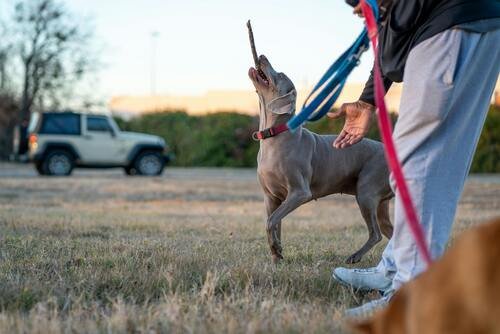
Dogs are nearly usually the ones working in crowded streets, hospital hallways, and airline terminals. Not because people have an emotional attachment to them, but rather because they have demonstrated throughout time that they are capable of handling responsibilities in a manner that other animals just cannot.
An animal that can be trained and one that can be trusted are two different things. Dogs clearly belong in the second group.
Cognitive Compatibility with Humans
Dogs don’t just “listen”, they read situations. A shift in tone, a pause in speech, a small hand gesture, these are signals they pick up on without needing repetition. Which is why they often respond correctly even when nothing is said directly.
A guide dog, for instance, isn’t blindly following commands. If a handler tells it to move forward into traffic, it won’t. That decision-making ability comes from understanding intent, not just instruction.
Other animals can learn patterns, but the interaction often feels mechanical. With dogs, it feels responsive. That distinction becomes critical in real environments where instructions aren’t always clear or perfectly timed.
Behavioural Stability Under Pressure
Most environments where assistance animals operate are unpredictable. Loud sounds, sudden movement, crowded spaces, these aren’t exceptions; they’re the norm. Dogs, when properly trained, don’t lose control or get confused in these conditions. They stay steady. Not because they’re fearless, but because they’ve been conditioned to manage their response instead of reacting impulsively.
A police dog doesn’t get the luxury of hesitation. A medical alert dog doesn’t get a second attempt. The response has to be immediate and controlled. This kind of stability is hard to replicate. Many animals can perform well in calm settings, but consistency under pressure is where the gap becomes obvious.
Trainability and Behavioural Reinforcement
Here’s where things get more practical. Training a dog isn’t about tricks; it’s about building repeatable behaviour. And repeatability depends on structure. Dogs respond well to reinforcement systems that are consistent and predictable. Not excessive praise, not random rewards, just clear cause and effect. Do this, get that. Simple, but effective.
In structured training programs, even something as ordinary as dry dog food becomes useful. Not because it’s special, but because it’s consistent. Same portion, same response, every time. That removes variables, which is exactly what trainers want.
When rewards become unpredictable or overstimulating, behaviour starts to drift. Dogs, however, stay consistent when the routine is structured and predictable. It may look simple, but that consistency is what makes the training effective.
Physical and Environmental Adaptability
Dogs fit into human environments in a way that feels almost natural. They adjust. Whether it’s navigating stairs, sitting quietly in a waiting room, or moving through a crowded street, they learn the rhythm of human spaces.
Size also plays a role. Larger breeds can support mobility tasks, while smaller ones are better suited for close-contact roles like emotional support. That flexibility means one species can cover a wide range of needs without forcing adaptation from the environment.
Most animals don’t offer that range. They either fit the space, or they don’t.
Social Integration and Public Acceptance
There’s also a reality people don’t like to admit: acceptance matters. Dogs are familiar. People understand their presence. They don’t question it in the same way they might with less common animals. That reduces resistance in public settings, especially in places where calm and order are expected.
An assistance animal shouldn’t become the centre of attention. Dogs avoid that problem by default.
Emotional Intelligence and Bond Formation
Beyond tasks, there’s something quieter happening. Dogs tend to form steady, predictable bonds with the people they assist. That consistency becomes part of a person’s routine, especially in long-term care or therapy. It’s not about affection in a sentimental sense; it’s about reliability. The same presence, the same response, day after day.
There’s also a measurable impact. Interaction with dogs has been linked to reduced stress levels and improved emotional balance in clinical settings. That kind of effect isn’t easily engineered. It emerges from consistency over time.
Why Other Animals Fall Short
It’s not that other animals lack ability. Some are intelligent. Some are strong. Some can even be trained to perform specific tasks. But very few combine all the necessary traits at once, such as trainability, stability, adaptability, and responsiveness.
In most cases, the limitation shows up quickly. Some animals learn tasks but struggle to repeat them in new environments. Others respond well in training but become unreliable when conditions change. Dogs are different because they can carry the same behaviour from training into real situations without losing consistency.
Conclusion
The continuous reliance on dogs in assistance roles is determined by results rather than preferences. They have demonstrated throughout time that they can manage the task without adding needless risk in a variety of settings and demands.
Until another animal can match that level of consistency across the board, dogs won’t be replaced. Not because alternatives don’t exist, but because they don’t hold up when it matters.